High compression topic, dish vs flat top vs dome.
Page 1 of 3 • 1, 2, 3 
High compression topic, dish vs flat top vs dome.
richter69 September 22nd 2010, 6:47 pm
No blowers, no nitrous, no turbo's, I'm talking n/a and even lean more toward an alcohol point of view.

richter69- Posts : 13649
Join date : 2008-12-02
Age : 53
Location : In the winners circle
Re: High compression topic, dish vs flat top vs dome.
Curt September 22nd 2010, 7:03 pm
 ).
). Compression is free horsepower, but everything has it limits.

Curt- Posts : 2787
Join date : 2009-02-08
Age : 61
Location : Henrietta, Texas but mostly on the road
Re: High compression topic, dish vs flat top vs dome.
Lem Evans September 22nd 2010, 7:25 pm
LLLLLLLLLLLLLLLLLLLLLLLLLLLLLLLLLLL
That's all you guys have

Lem Evans- Posts : 7445
Join date : 2008-12-03
Location : Livermore , Ky -

Re: High compression topic, dish vs flat top vs dome.
jbozzelle September 22nd 2010, 7:58 pm
jbozzelle- Posts : 3705
Join date : 2009-08-10
Age : 49
Location : New Orleans
Re: High compression topic, dish vs flat top vs dome.
Lem Evans September 22nd 2010, 8:04 pm
Lem Evans- Posts : 7445
Join date : 2008-12-03
Location : Livermore , Ky -
Re: High compression topic, dish vs flat top vs dome.
DanH September 22nd 2010, 8:15 pm
DanH- Posts : 1081
Join date : 2009-08-06
Re: High compression topic, dish vs flat top vs dome.
bruno September 22nd 2010, 8:17 pm

Wedge engines like three things because of their port geometry and valve arrangement. These are:
First, a tight chamber on the exhaust side to reduce flow on the side entering to the bottom of the port. Too much flow here cuts off overall port flow because inertia causes this flow to swing toward the top of the port which then blocks the flow trying to enter the port from the center of the cylinder.
Second, is intake swirl. This is enhanced when the cylinder wall side of the chamber swings in a mild parabolic shape from the side of the valve toward the spark plug. An open chamber allows the flow to slow too quickly and swirl is lost.
Third, is spark plug location. The most effective location is near the center of the cylinder favoring the exhaust valve. This reduces burn time since the burn radiates in all directions from a central point rather than starting in one corner and progressing the entire bore distance. The exhaust valve is the hottest item in the combustion chamber and is a known source of preignition or a cause for detonation. By moving the spark plug close to that point, the burn is initiated there and this provides better control since ignition or explosion caused by the hot valve doesn't happen when it's already covered with burnt products. Of course we're not talking mich time the difference between old and lazy heads and modern fastburn chambers is a hand full of milli-seconds. But what a difference those few milli-seconds makes.
OK, I'm getting to dish versus flat tops versus domes.
Remember I mentioned squish and quench, these are functions of that flat side of the combustion chamber. Both of these functions are aided by as close a closure of the piston's deck to the head's deck as is possible to achieve within mechanical limitations.
First in the compression cycle squish happens as these two sections close on each other. This drives the mixture in this area back into the chamber by the spark plug with great force. The resulting turbulence and high density makes for a fast and complete burn when the plug ignites it. This reduces the amount of timing lead which reduces early forces in the combustion process that want to drive the piston back the way it came, which results in power lost. It also delays peak cylinder pressure and temperature to a moment when the piston is headed down the bore in the proper direction. This effect is to reduce the tendency to detonate.
The second event after ignition is that the close proximity of the piston and head decks perform what's called "quench". This is where the hot end-burn gases that like to detonate are trapped between two relatively cool surfaces with a lot of area compared to the volume. This sucks a lot of heat out and prevents detonation.
A third feature of modern heads is the beak that protrudes from the squish/quench deck between the valves. This helps prevent incoming mixture from being sucked thru the exhaust during the cam's overlap phase. The result is a denser mixture upon compression and more power and efficiency. Of course this dampens out the rough idle of a big cam. But it trades the rumpty rump idle for more power, better fuel economy and lower emissions.
Now if you have a flat top piston with a .040 inch clearance on the squish/quench side, the effects of squish and quench are maximized by how close the piston and head deck close with each other. The effect is the same with a "D" dish piston where the dish is all under the valve pocket. However, a piston with a circular dish cannot close any more than the raised rim of the piston crown. So even if this crown is .040 inch away from the head's squish/quench deck the floor of the dish is a considerable distance away and it cannot and does not expel the mixture toward the plug with sufficient force upon compression to throughly agitate the mixture for the most effective burn. At the post ignition point, it does not provide the high surface area to volume ratio of a flat top so that the late burn's excessively high temps are not damped. Both of these conditions lead to reduced power as on the squish phase the burn is slower and weaker requiring more timing lead which has the effect of first trying to drive the piston backwards and second increases cylinder pressure and temperature too early which combined with inadequate quench leads to detonation and preignition.
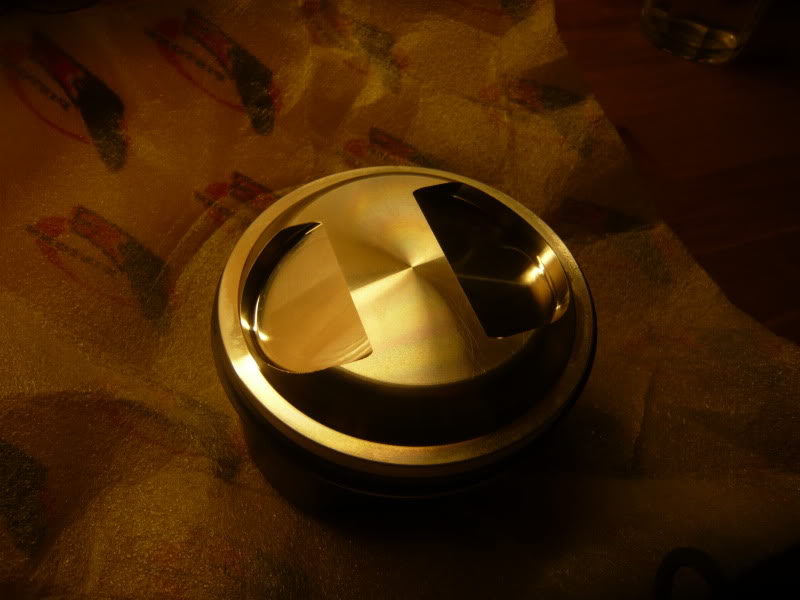
The problem with a domed piston is that it slows the burn speed by both reducing mixture agitation toward the spark plug and causes the burn to have to travel over and around it. The response to this is to add more timing lead and to run excessively rich mixtures to use evaporation of the fuel to cool the burn under the detonation limit. The optimum end game becomes one of finding the best chamber size against the dome size that results in the most power. Efficiency and emissions not being a consideration at these elevated compression ratios over about 10 to 1.
_________________
coming soon x275 build .........
thanks to all my sponsors :
www.OakleyMotorsports.com
www.Induction-Solutions.com
www.bfevansraceparts.com
www.ultimateconverter.com
www.keithfulpmotorsports.com

bruno- Moderator

- Posts : 10873
Join date : 2008-12-02
Age : 51
Location : MILLBROOK , AL. -
Re: High compression topic, dish vs flat top vs dome.
Curt September 22nd 2010, 8:21 pm

Here is a nice dome
Curt- Posts : 2787
Join date : 2009-02-08
Age : 61
Location : Henrietta, Texas but mostly on the road
Re: High compression topic, dish vs flat top vs dome.
Curt September 22nd 2010, 8:24 pm
Curt- Posts : 2787
Join date : 2009-02-08
Age : 61
Location : Henrietta, Texas but mostly on the road
Re: High compression topic, dish vs flat top vs dome.
DanH September 22nd 2010, 8:31 pm
DanH- Posts : 1081
Join date : 2009-08-06
Re: High compression topic, dish vs flat top vs dome.
KY JELLY September 22nd 2010, 8:49 pm


KY JELLY- Posts : 1530
Join date : 2008-12-03
Re: High compression topic, dish vs flat top vs dome.
richter69 September 22nd 2010, 9:49 pm
Last edited by richter69 on September 23rd 2010, 6:44 pm; edited 1 time in total
richter69- Posts : 13649
Join date : 2008-12-02
Age : 53
Location : In the winners circle
Re: High compression topic, dish vs flat top vs dome.
Lem Evans September 22nd 2010, 10:11 pm
I'd think you should get a copy of the 2010 BBF Winter Tech Seminar and review Darin Morgan's talk before you copy/paste .bruno wrote:Great subject Jon ... did some reading
Wedge engines like three things because of their port geometry and valve arrangement. These are:
First, a tight chamber on the exhaust side to reduce flow on the side entering to the bottom of the port. Too much flow here cuts off overall port flow because inertia causes this flow to swing toward the top of the port which then blocks the flow trying to enter the port from the center of the cylinder.
Second, is intake swirl. This is enhanced when the cylinder wall side of the chamber swings in a mild parabolic shape from the side of the valve toward the spark plug. An open chamber allows the flow to slow too quickly and swirl is lost.
Third, is spark plug location. The most effective location is near the center of the cylinder favoring the exhaust valve. This reduces burn time since the burn radiates in all directions from a central point rather than starting in one corner and progressing the entire bore distance. The exhaust valve is the hottest item in the combustion chamber and is a known source of preignition or a cause for detonation. By moving the spark plug close to that point, the burn is initiated there and this provides better control since ignition or explosion caused by the hot valve doesn't happen when it's already covered with burnt products. Of course we're not talking mich time the difference between old and lazy heads and modern fastburn chambers is a hand full of milli-seconds. But what a difference those few milli-seconds makes.
OK, I'm getting to dish versus flat tops versus domes.
Remember I mentioned squish and quench, these are functions of that flat side of the combustion chamber. Both of these functions are aided by as close a closure of the piston's deck to the head's deck as is possible to achieve within mechanical limitations.
First in the compression cycle squish happens as these two sections close on each other. This drives the mixture in this area back into the chamber by the spark plug with great force. The resulting turbulence and high density makes for a fast and complete burn when the plug ignites it. This reduces the amount of timing lead which reduces early forces in the combustion process that want to drive the piston back the way it came, which results in power lost. It also delays peak cylinder pressure and temperature to a moment when the piston is headed down the bore in the proper direction. This effect is to reduce the tendency to detonate.
The second event after ignition is that the close proximity of the piston and head decks perform what's called "quench". This is where the hot end-burn gases that like to detonate are trapped between two relatively cool surfaces with a lot of area compared to the volume. This sucks a lot of heat out and prevents detonation.
A third feature of modern heads is the beak that protrudes from the squish/quench deck between the valves. This helps prevent incoming mixture from being sucked thru the exhaust during the cam's overlap phase. The result is a denser mixture upon compression and more power and efficiency. Of course this dampens out the rough idle of a big cam. But it trades the rumpty rump idle for more power, better fuel economy and lower emissions.
Now if you have a flat top piston with a .040 inch clearance on the squish/quench side, the effects of squish and quench are maximized by how close the piston and head deck close with each other. The effect is the same with a "D" dish piston where the dish is all under the valve pocket. However, a piston with a circular dish cannot close any more than the raised rim of the piston crown. So even if this crown is .040 inch away from the head's squish/quench deck the floor of the dish is a considerable distance away and it cannot and does not expel the mixture toward the plug with sufficient force upon compression to throughly agitate the mixture for the most effective burn. At the post ignition point, it does not provide the high surface area to volume ratio of a flat top so that the late burn's excessively high temps are not damped. Both of these conditions lead to reduced power as on the squish phase the burn is slower and weaker requiring more timing lead which has the effect of first trying to drive the piston backwards and second increases cylinder pressure and temperature too early which combined with inadequate quench leads to detonation and preignition.
The problem with a domed piston is that it slows the burn speed by both reducing mixture agitation toward the spark plug and causes the burn to have to travel over and around it. The response to this is to add more timing lead and to run excessively rich mixtures to use evaporation of the fuel to cool the burn under the detonation limit. The optimum end game becomes one of finding the best chamber size against the dome size that results in the most power. Efficiency and emissions not being a consideration at these elevated compression ratios over about 10 to 1.
Lem Evans- Posts : 7445
Join date : 2008-12-03
Location : Livermore , Ky -
Re: High compression topic, dish vs flat top vs dome.
Curt September 22nd 2010, 10:19 pm
Curt- Posts : 2787
Join date : 2009-02-08
Age : 61
Location : Henrietta, Texas but mostly on the road
Re: High compression topic, dish vs flat top vs dome.
Lem Evans September 22nd 2010, 10:25 pm
Lem Evans- Posts : 7445
Join date : 2008-12-03
Location : Livermore , Ky -
Re: High compression topic, dish vs flat top vs dome.
bbf-falcon September 22nd 2010, 10:33 pm
Lem Evans wrote:Three options.......small dome, flat top or dish. None of which includes milling a head excessively.
HotDamn,That means I've got the Hot setup
bbf-falcon- Posts : 8995
Join date : 2008-12-03
Location : Jackson, Ohio
Re: High compression topic, dish vs flat top vs dome.
IDT-572 September 22nd 2010, 10:48 pm
Lem Evans wrote:Three options.......small dome, flat top or dish. None of which includes milling a head excessively.
Sometimes you got to do what the customer wants brother....................

IDT-572- BBF CONTRIBUTOR
- Posts : 4628
Join date : 2008-12-02
Age : 63
Location : Shelbyville Tn.
Re: High compression topic, dish vs flat top vs dome.
DanH September 22nd 2010, 10:57 pm
I didn't know you could get 14 to 17 CR with a small dome in a 468 cube A460 head engine , thats without excessive cutting the head .Lem Evans wrote:Three options.......small dome, flat top or dish. None of which includes milling a head excessively.
DanH- Posts : 1081
Join date : 2009-08-06
Re: High compression topic, dish vs flat top vs dome.
cool40 September 22nd 2010, 10:59 pm
me too!bbf-falcon wrote:Lem Evans wrote:Three options.......small dome, flat top or dish. None of which includes milling a head excessively.
HotDamn,That means I've got the Hot setup
 small dome and milled the heads excessively!
cool40- BBF CONTRIBUTOR
- Posts : 7308
Join date : 2009-08-31
Age : 53
Location : on the 1/8 mile dyno
Re: High compression topic, dish vs flat top vs dome.
Lem Evans September 23rd 2010, 9:58 am
The original post was by richter69....he referenced Mr. KY. Both have 562" engines.......that is the context of my statement.DanH wrote:I didn't know you could get 14 to 17 CR with a small dome in a 468 cube A460 head engine , thats without excessive cutting the head .Lem Evans wrote:Three options.......small dome, flat top or dish. None of which includes milling a head excessively.
Lem Evans- Posts : 7445
Join date : 2008-12-03
Location : Livermore , Ky -
Re: High compression topic, dish vs flat top vs dome.
DanH September 23rd 2010, 10:33 am
Lem , if you can show where anyone else was mention . I see it as a general question . there is many specfic applications . . Randy did give one - bus engine with a dome , which is under 500 inchrichter69 wrote:Ky brings up some points in my thread on the other site, I didn't start this topic to be a dick (for a change), but rather for general information. I'm not talking about 10-1 pump gas crap, but rather 14-17 to one "race" compression and how its achieved...........and how is one type of piston shape better than the other? And at what point is too much for a specific application.
No blowers, no nitrous, no turbo's, I'm talking n/a and even lean more toward an alcohol point of view.
DanH- Posts : 1081
Join date : 2009-08-06
Re: High compression topic, dish vs flat top vs dome.
DanH September 23rd 2010, 10:39 am
Jon also works on a small blockLem Evans wrote:The original post was by richter69....he referenced Mr. KY. Both have 562" engines.......that is the context of my statement.DanH wrote:I didn't know you could get 14 to 17 CR with a small dome in a 468 cube A460 head engine , thats without excessive cutting the head .Lem Evans wrote:Three options.......small dome, flat top or dish. None of which includes milling a head excessively.
DanH- Posts : 1081
Join date : 2009-08-06
Re: High compression topic, dish vs flat top vs dome.
Lem Evans September 23rd 2010, 10:44 am
Lem Evans- Posts : 7445
Join date : 2008-12-03
Location : Livermore , Ky -
Re: High compression topic, dish vs flat top vs dome.
richter69 September 23rd 2010, 10:50 am
I have nothing against domes, or using them to get to a certain number.
Last edited by richter69 on September 23rd 2010, 6:43 pm; edited 2 times in total
richter69- Posts : 13649
Join date : 2008-12-02
Age : 53
Location : In the winners circle
Re: High compression topic, dish vs flat top vs dome.
bbf-falcon September 23rd 2010, 11:08 am
bbf-falcon- Posts : 8995
Join date : 2008-12-03
Location : Jackson, Ohio
Page 1 of 3 • 1, 2, 3
Similar topics» Looking for 4.440 1.250ch A460 pistons flat top or dish
» High compression and turbo ?'s
» High compression and dual batteries
» Looking for ideas on how to build a high compression 429
|
|
|